
Home » Products » Chromatography/Mass Spectrometry » Elemental Analysis » Shimadzu Atomic Absorption Spectrophotometer
Atomic Absorption Spectrophotometer
|
Precision Elemental Quantification via Atomic Absorption Spectroscopy
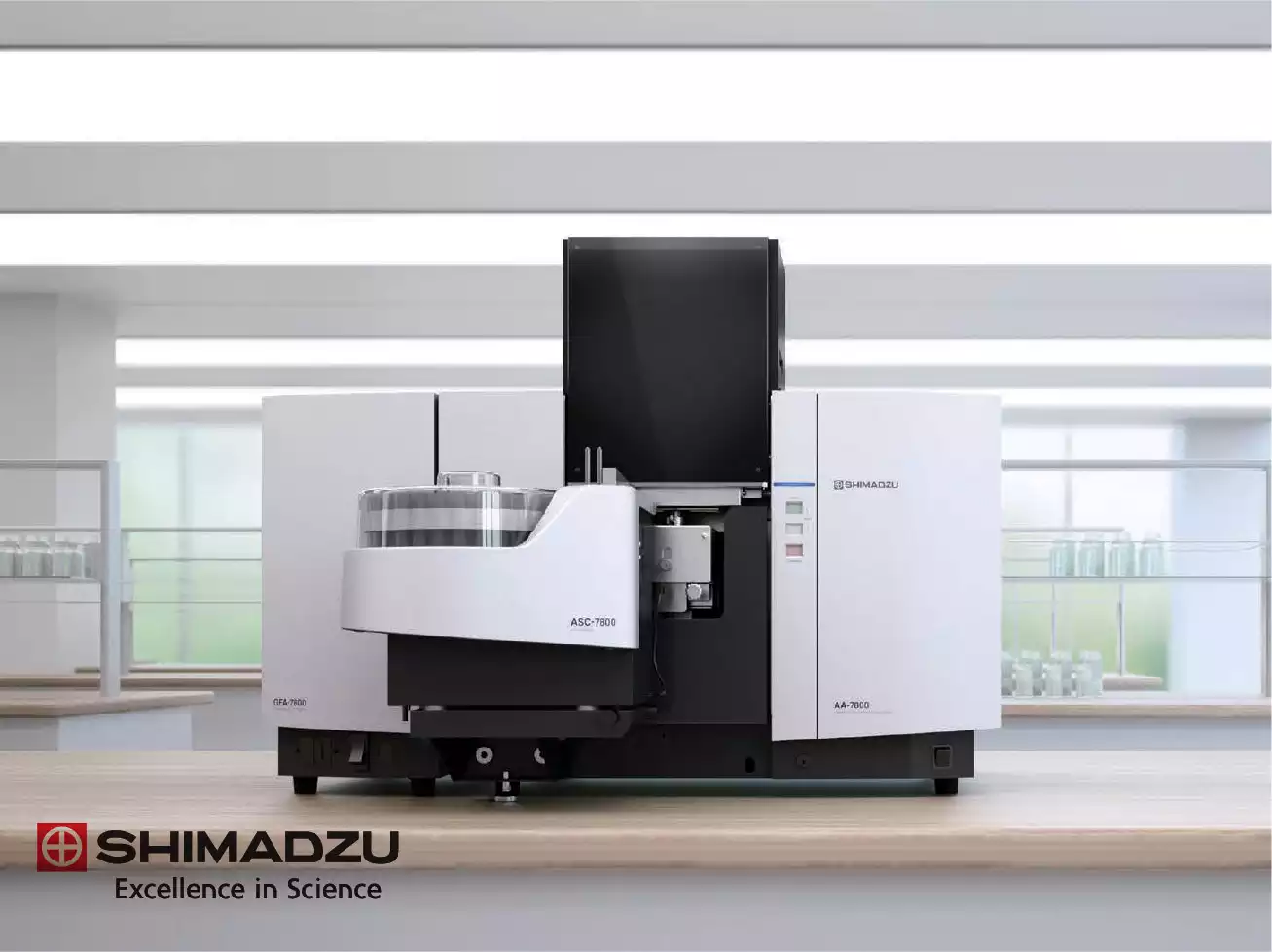
Shimadzu Atomic Absorption Spectrophotometer
Shimadzu’s Atomic Absorption Spectroscopy (AAS) solutions are technically founded on the integration of high-performance hardware with advanced "Analytical Intelligence" to ensure both high-fidelity results and operator safety. This synergy is particularly evident in the transition between different atomization modes where the software automatically optimizes optical alignment and gas parameters.
By combining these safety protocols with a robust optical bench and dual-background correction, Shimadzu provides a stable technical framework that minimizes the environmental and operational variables that can compromise trace metal determination, ensuring data integrity across a wide range of industrial and environmental applications.
Optimization of Sample Atomization and Desolvation
The flame atomization unit is technically engineered to achieve a uniform and stable aerosol through high-precision nebulization. By adjusting the impact bead and gas-to-liquid ratios, the system ensures that the sample is efficiently desolvated before entering the flame. This technical optimization is crucial for minimizing physical interferences and maintaining a steady absorbance signal for elements that require high-temperature air-acetylene or nitrous oxide-acetylene flames.
Advanced Temperature Control in Graphite Furnace
Technically, the graphite furnace utilizes a sophisticated feedback loop involving optical sensors to manage heating rates. This allows for precise control over the drying, ashing, and atomization stages. By implementing a high-speed temperature ramp, the furnace achieves a dense cloud of atoms in the light path, which significantly enhances the sensitivity and detection limits for volatile and refractory elements in complex matrices.
Deuterium Lamp Background Correction Efficiency
The deuterium ($D_2$) lamp method is a technical cornerstone for correcting non-specific absorption in the ultraviolet region. By utilizing a continuous light source alongside the hollow cathode lamp, the system measures the total absorbance and the background absorbance simultaneously. The software then subtracts the background component in real-time, ensuring that the reported absorbance is solely due to the target element, even in samples with high smoke or molecular absorption.
Self-Reversal (SR) Method for Structured Backgrounds
For samples with complex spectral backgrounds that a $D_2$ lamp cannot resolve, the Self-Reversal method provides a technical alternative. By pulsing the hollow cathode lamp with a high current, the emission line is broadened and "reversed" at the center. This allows the system to measure the background absorption exactly at the analytical wavelength without requiring a separate lamp, providing superior correction for structured interferences.
Motorized Lamp Turret for Multi-Element Sequences
To support high-throughput operations, the instruments feature a motorized lamp turret that can house multiple hollow cathode lamps. Technically, the software controls the turret's rotation and performs automatic peak-searching and alignment for each lamp in the sequence. This automation allows for unattended multi-element analysis, where the system automatically switches between target metals and re-optimizes the optical path for each measurement.
High-Resolution Optical Monochromator Performance
The technical precision of the AAS system is heavily dependent on its Czerny-Turner monochromator. This component is designed to provide high spectral resolution and excellent light throughput. By isolating the specific analytical line from other lamp emissions or flame background, the monochromator ensures high selectivity and minimizes spectral overlaps, which is essential for maintaining linear calibration curves and high sensitivity.
Safety Interlock Systems and Flashback Prevention
A critical technical feature of Shimadzu AAS is its comprehensive safety interlock system. Sensors monitor the burner head type, the drain tank's water seal, and the gas pressure. If a technical anomaly is detected, such as a flame flashback or a drop in oxidant pressure, the system triggers an emergency shutdown, cutting off the gas supply and extinguishing the flame to prevent instrument damage and ensure a safe laboratory environment.
Hydride Generation for Trace Volatile Metals
For the determination of elements like Mercury, Arsenic, and Selenium, a hydride generation accessory is technically utilized. This unit converts the dissolved analytes into gaseous hydrides through chemical reduction. The gases are then swept into a specialized heated cell in the optical path. This separation from the liquid matrix drastically reduces chemical interferences and lowers detection limits by orders of magnitude compared to standard flame aspiration.
Click here for more information about Shimadzu range of products